
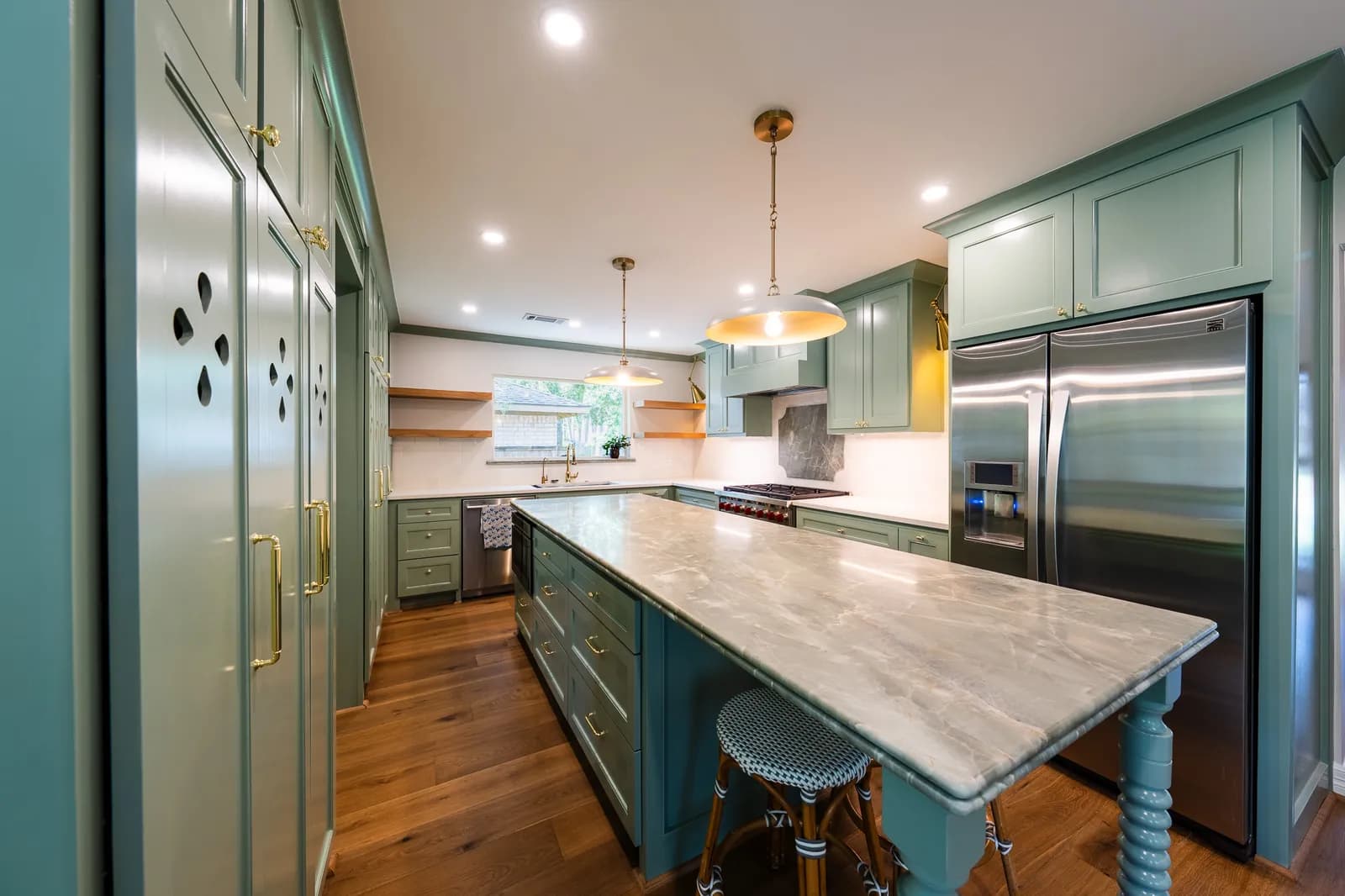
It is one of the most common questions we hear at the first consultation: "If we can only do one right now — the kitchen or the bathroom — which one is the smarter investment?" The honest answer is that both perform well in Houston, but they pay you back in different ways, on different timelines, and for different reasons. Understanding those differences is far more useful than a single national ROI percentage.
Below is how we frame the decision for Houston homeowners, drawing on resale data, appraiser behavior, and what we see buyers respond to across the neighborhoods we work in — from Memorial and Spring Valley to Sugar Land, Katy, and Kingwood.
What the ROI Data Actually Says
National cost-versus-value studies consistently show midscale bathroom remodels recouping roughly 65–75% of their cost at resale, with midscale kitchen remodels close behind in the 60–75% range. Upscale versions of both projects recoup a lower percentage on paper — typically 50–60% — because the dollar amounts are larger, not because the work is less valuable.
Two caveats matter for Houston specifically. First, these are national averages; Houston's strong buyer demand for updated, move-in-ready homes tends to compress days-on-market dramatically for remodeled properties, and speed of sale is a form of return the studies do not capture. Second, ROI-at-resale is only half the equation. If you plan to stay in your home for five, ten, or fifteen years, the daily-use value of the space you actually live in should weigh at least as heavily as the resale math.
The Case for the Kitchen
The kitchen is the room that sells a Houston home. Buyers walk into the kitchen first, photograph it first, and judge the whole house by it. A dated kitchen drags down the perceived value of every other room, while a beautifully executed one lifts it. Appraisers treat kitchen quality as a primary condition adjustment, and listing agents consistently lead with kitchen photography for a reason.
Kitchens also touch more of daily life than any other room — cooking, homework, entertaining, morning coffee. When homeowners tell us a remodel changed how their family uses the house, it is almost always the kitchen they are talking about. The investment is larger than a bathroom, but the surface area of life it improves is larger too.
The Case for the Bathroom
Bathrooms are the efficiency play. The total investment is meaningfully lower than a kitchen, the timeline is shorter, and the percentage recouped at resale is often slightly higher. A primary bathroom remodel — walk-in shower, freestanding tub, double vanity, quality tile — delivers a daily luxury experience for a fraction of a kitchen's cost.
There is also a defensive argument that applies with real force in Houston: bathrooms are where water damage starts. Failing shower pans, cracked grout, aging drain lines, and poor ventilation in our humid climate quietly damage framing and slabs for years before they announce themselves. Remodeling an aging bathroom with proper waterproofing is not just a cosmetic upgrade — it is protection for the structure around it.
One more Houston-specific note: in established neighborhoods with homes from the 1960s–1980s, original bathrooms are often the single most dated rooms in the house. Bringing one up to modern standards can remove the biggest objection a future buyer would have — at the lowest cost of any major remodel.
So Which Should You Do First?
When homeowners need a decision framework, we walk them through four questions.
- How long are you staying? Selling within two to three years favors the project that fixes your home's weakest room in buyers' eyes. Staying long-term favors the room you use most.
- Which room is functionally failing? Active leaks, failing waterproofing, or an unusable layout jump the line regardless of ROI percentages.
- What does your neighborhood expect? In areas like Memorial or Sugar Land, buyers at your price point expect both rooms to be done. If comparable homes have remodeled kitchens, an original kitchen costs you more at sale than the remodel would.
- What does the whole-house plan look like? If a kitchen remodel is coming eventually and might involve moving walls or plumbing, sequencing matters — remodeling an adjacent bathroom first can mean redoing work later.
A Third Option: Phasing Both
The kitchen-versus-bathroom question often has a better answer than "pick one": sequence both over twelve to twenty-four months. Because a design-build firm carries the design work, selections, and pricing for both projects at once, phasing lets you lock a coherent whole-house design language — the same quality of cabinetry, coordinating stone, consistent hardware finishes — while spreading the investment across two calendar years. It also means the disruption never overlaps: you always have a fully functioning kitchen or a fully functioning primary bath while the other room is under construction.
Phasing pays a quiet dividend at resale, too. Appraisers and buyers reward consistency; a home where the kitchen and bathrooms clearly belong to the same renovation reads as "fully updated" rather than "partially updated," and that distinction shows up in comparable-sale adjustments.
The Answer Most Houston Homeowners Land On
If the honest driver is resale value in the near term, the kitchen usually wins in Houston — it is the room that anchors the appraisal and the listing. If the driver is value per dollar, speed, and protecting the house itself, the bathroom is hard to beat. And for homeowners planning to stay put, the right answer is usually the room that frustrates you every single day, because you will collect that return every morning for years.
The best way to decide is to look at both projects scoped against your actual home and your actual timeline. We regularly design kitchen and bathroom projects in phases so the work, the disruption, and the investment are sequenced sensibly. If you are weighing the two, bring us the question — a one-hour consultation usually settles it.