
If you ask five Houston contractors what a kitchen remodel costs, you will get five different answers — and most of them will be vague on purpose. The honest answer is that the number depends almost entirely on three things: the quality of the materials you select, whether the layout changes, and the standard of craftsmanship behind the installation. A kitchen is the hardest-working room in the house, and the difference between a remodel that looks good on day one and one that still functions beautifully in year fifteen comes down to decisions made long before demolition begins.
In this guide, we break down the investment tiers we see across the Houston market, the specific line items that drive the total, and the local factors — permitting, foundations, older-neighborhood plumbing — that make remodeling here different from remodeling anywhere else in the country.
Houston Kitchen Remodel Investment Tiers
Rather than a single number, it helps to think in tiers defined by material quality and scope. In the Houston metro, most full kitchen remodels fall into one of three ranges.
- Quality-focused mid-range: roughly $45,000–$85,000. Semi-custom cabinetry, quartz or granite countertops, tile backsplash, updated lighting and plumbing fixtures, and new flooring — with the existing layout largely intact. This tier prioritizes durable materials and clean execution over dramatic structural change.
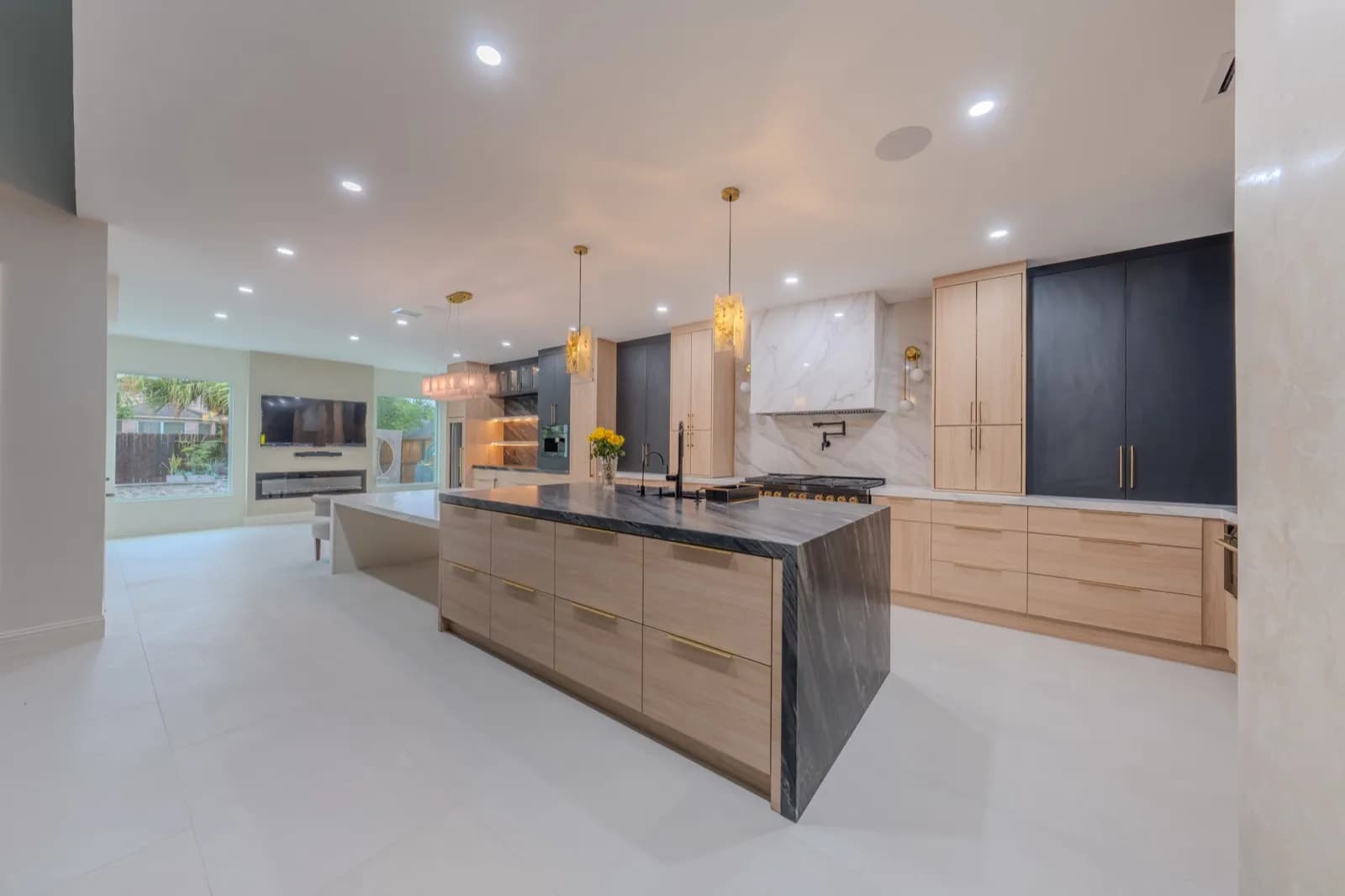
- Custom luxury: roughly $90,000–$175,000. Fully custom cabinetry built to the room, natural stone or premium quartz with waterfall edges, panel-ready appliances, layout reconfiguration (walls moved, islands enlarged, windows added), and designer lighting. Most of the kitchens in our portfolio live in this tier.
- Estate-level: $175,000 and up. Structural expansion of the kitchen footprint, architectural millwork throughout, professional-grade appliance suites, specialty features like butler's pantries, wine storage, or integrated bar areas.
Cabinetry: The Single Biggest Line Item
Cabinetry typically consumes 30–40% of a kitchen remodel investment, and it is the decision that most defines both the look and the longevity of the finished room. Stock cabinets arrive in fixed sizes with filler strips hiding the gaps; semi-custom lines offer more flexibility; fully custom cabinetry is built to the exact dimensions of your kitchen, with soft-close hardware, dovetailed drawer boxes, and finishes applied in a controlled shop environment.
In our experience, cabinetry is the worst place to compromise. Doors and drawers get opened tens of thousands of times over a kitchen's life, and the difference between particleboard boxes and plywood construction with quality hardware shows up within a few years — especially in Houston's humidity, which punishes lesser materials.
Stone, Countertops, and Surfaces
Countertops usually account for 10–15% of the total. Quartz remains the most popular choice in Houston for its consistency and near-zero maintenance, while natural stones like quartzite, marble, and granite offer one-of-a-kind character at a premium. Beyond the slab itself, fabrication details matter: mitered waterfall edges, full-height stone backsplashes, and integrated drainboards all add fabrication labor — and all elevate the finished result in ways homeowners notice every single day.
Layout Changes and Structural Work
Keeping plumbing, gas, and electrical where they are is the most efficient path. The moment a wall comes down or a sink moves across the room, the project involves structural engineering, re-routed utilities, and additional permitting — often adding $10,000–$30,000 or more depending on scope. That said, layout changes are frequently where the real transformation happens. Many Houston homes from the 1970s through the 1990s were built with closed-off kitchens, and opening the space to the living area is often the single highest-impact decision in the entire remodel.
Because Houston homes sit on slab foundations, moving a sink or island means trenching into the concrete slab to re-route drain lines — very doable, but it is skilled work that should be scoped and priced accurately up front, not discovered mid-project.
Houston-Specific Factors That Shape the Number
Remodeling in Houston comes with local realities that a national cost calculator will never capture.
- Permitting: within Houston city limits, projects involving structural, electrical, plumbing, or mechanical changes require permits through Houston Permitting Center. A well-run design-build firm handles this entirely — but it is real time and real cost that belongs in the plan.
- Slab-on-grade foundations: nearly universal here, which affects the cost of relocating plumbing compared to markets with basements or crawl spaces.
- Humidity and ventilation: proper range ventilation and material selection matter more in the Gulf Coast climate. Painted finishes, wood species, and adhesives all need to be specified with humidity in mind.
- Older-neighborhood infrastructure: homes in Memorial, Meyerland, Braeswood, and other established areas often have aging cast-iron drain lines or dated electrical panels that should be evaluated — and sometimes updated — while the walls are open.
- Deed restrictions: many Houston neighborhoods enforce deed restrictions in place of zoning, and some remodels that touch the exterior require HOA or civic-association review.
How to Get a Real Number for Your Kitchen
The most reliable way to understand what your kitchen will cost is a detailed scope built around your actual home: measured drawings, specific material selections, and a line-item proposal rather than a per-square-foot guess. That is the core of the design-build approach — design decisions and pricing develop together, so the number you approve is the number the project is built to.
It is also worth knowing that a kitchen remodel does not have to be paid as a single lump sum. Financing options exist for exactly this kind of project, and we walk homeowners through them during the consultation — you can learn more on our financing page.
A kitchen built with quality materials and disciplined craftsmanship is not an expense; it is one of the few home investments you get to enjoy every day while it holds its value. If you are weighing a kitchen remodel in Houston, start with a conversation about scope and priorities — the numbers get much clearer from there.